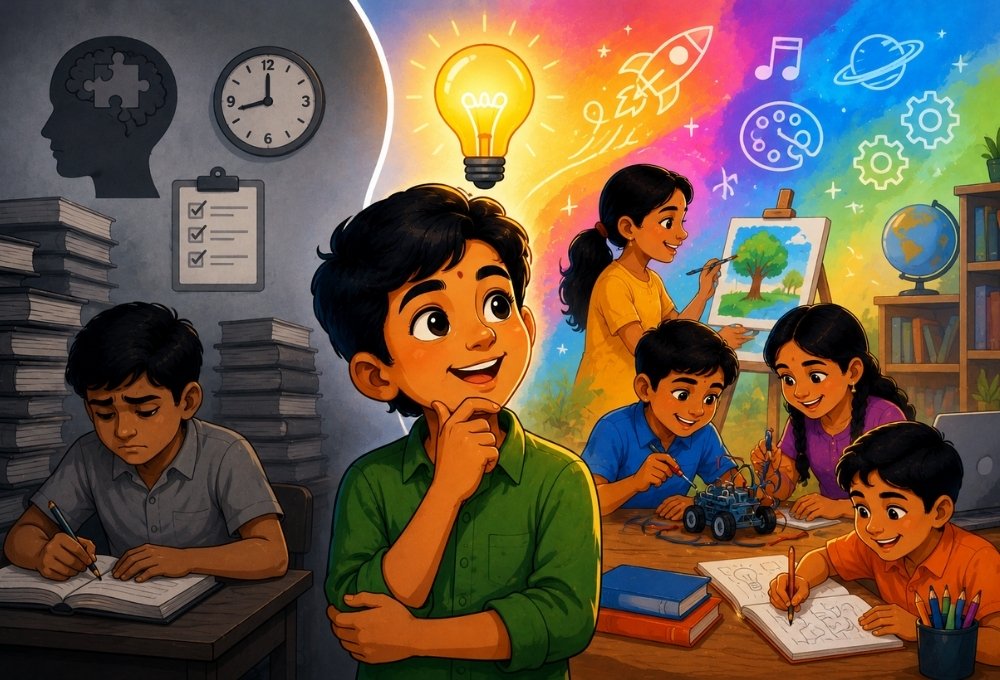

For decades, traditional education systems around the world have largely rewarded memorization. Students were often trained to reproduce information accurately in examinations, and academic success was measured by how well children could retain and repeat content. While memorization still plays a role in learning, the modern world increasingly demands a very different set of abilities.
Today, children are growing up in an era shaped by Artificial Intelligence, automation, rapid technological change, and constant access to information. Facts and information are now available instantly through digital platforms and AI-powered tools. As a result, the ability to simply remember information is becoming less valuable than the ability to think creatively with information.
This shift is transforming the future of education.
Modern learning environments increasingly prioritize creativity because creativity enables children to adapt, innovate, solve problems, communicate ideas, and think independently in situations where there are no predefined answers.
At The Gift School, creativity is viewed not merely as an artistic skill, but as a foundational human ability that influences confidence, communication, leadership, and long-term future readiness.
The World No Longer Rewards Memorization Alone
Traditional memorization-based learning emerged during an industrial era where education systems were designed to produce standardized outcomes. Students were expected to follow instructions, repeat established methods, and fit into structured systems.
However, the modern world functions very differently.
Technology now performs many repetitive and information-based tasks faster than humans. Artificial Intelligence can retrieve facts, summarize content, generate written responses, and process large amounts of information almost instantly.
What technology still struggles to replicate consistently is:
- imagination
- original thinking
- emotional understanding
- innovation
- creative problem-solving
- human expression
These are the abilities that increasingly shape future success.
Children growing up today will likely enter careers that do not yet fully exist. In such an environment, adaptability and creativity become more valuable than memorizing fixed answers.
Creativity Helps Children Learn How to Think
One of the greatest advantages of creativity is that it teaches children how to think independently rather than simply what to think.
Creative learning encourages children to:
- explore possibilities
- ask questions
- experiment with ideas
- solve problems differently
- express unique perspectives
This process strengthens intellectual flexibility, which is essential in a rapidly changing world.
Children who rely entirely on memorization may perform well in structured examinations but often struggle when faced with unfamiliar or unpredictable situations. Creative thinkers, on the other hand, are generally more adaptable because they are comfortable exploring solutions beyond fixed patterns.
Creativity therefore supports both academic growth and long-term resilience.
Creativity Strengthens Problem-Solving Ability
Problem-solving is one of the most important future-ready skills for students. Real-world challenges rarely come with clear textbook answers. They often require flexibility, imagination, communication, and experimentation.
Creative children learn how to approach problems from multiple perspectives. They become more willing to test ideas, learn from mistakes, and think beyond conventional solutions.
This mindset is increasingly valuable because future careers will reward individuals who can:
- innovate consistently
- adapt quickly
- create solutions independently
- think critically under uncertainty
Creativity helps children become comfortable with exploration rather than fear-driven perfectionism.
Why Creativity Improves Confidence
Creativity and confidence are deeply interconnected. Children often become more confident when they are given opportunities to express ideas freely without excessive fear of failure or judgment.
In highly rigid learning environments, children may begin to associate learning with correctness alone. Over time, this can create anxiety around making mistakes or expressing original ideas.
Creative learning environments, however, encourage participation, experimentation, and expression. Activities such as storytelling, music, photography, filmmaking, drama, and collaborative projects allow children to communicate ideas in more personal and imaginative ways.
This helps children gradually develop:
- expressive confidence
- emotional comfort
- communication ability
- self-awareness
- social participation
Confidence grows when children feel that their ideas and creativity are valued.
Creativity Enhances Communication Skills
Creative children often become better communicators because creativity encourages expression. Whether children are telling stories, presenting ideas, building projects, or participating in discussions, creativity naturally strengthens communication.
Creative learning helps children:
- organize thoughts clearly
- explain ideas confidently
- communicate emotions effectively
- engage more actively in group settings
Communication and creativity work together because both require imagination, emotional awareness, and self-expression.
In many cases, creativity helps hesitant children become more expressive socially because it provides alternative pathways for participation beyond traditional academic structures.
The Relationship Between Creativity and Academic Performance
A common misconception is that creativity distracts children from academics. In reality, creative learning often improves academic engagement and comprehension.
Children learn more effectively when they are emotionally connected to what they are learning. Creativity increases curiosity and active participation, which strengthens understanding and long-term memory retention.
Creative learning environments often improve:
- curiosity and engagement
- critical thinking
- conceptual understanding
- classroom participation
- motivation to learn
Students who enjoy learning are more likely to become lifelong learners rather than passive memorization-driven learners.
Why Screen Time Cannot Replace Creative Learning
Modern children spend significant amounts of time consuming digital content passively. While technology provides educational opportunities, excessive passive consumption can sometimes reduce:
- imagination
- attention span
- social interaction
- active problem-solving
- expressive communication
Creativity requires active engagement rather than passive consumption.
When children participate in storytelling, artistic exploration, collaborative projects, communication activities, and hands-on experiences, they develop intellectual and emotional flexibility that passive screen interaction cannot fully replace.
Balanced childhood development requires both technological exposure and creative human interaction.
Creativity Is One of the Most Valuable Skills in the AI Era
As Artificial Intelligence becomes increasingly capable of processing information, creativity is becoming one of the most valuable human abilities.
Future workplaces will increasingly prioritize:
- innovation
- adaptability
- emotional intelligence
- communication
- leadership
- creative thinking
The ability to generate original ideas and communicate them effectively will remain deeply valuable even as technology evolves.
Children who develop creativity early are often better prepared to adapt to future uncertainty because they become comfortable thinking independently and approaching challenges with flexibility.
How The Gift School Encourages Creative Learning
At The Gift School Summer Camp 2026, creativity is integrated into interactive learning experiences designed to help students become expressive, confident, and future-ready.
Students participate in activities that encourage:
- storytelling and communication
- collaborative learning
- creative expression
- leadership development
- confidence-building
- practical problem-solving
The focus is not simply on artistic output, but on helping children develop the mindset and adaptability required for the modern world.
This holistic learning approach helps students grow intellectually, emotionally, socially, and creatively.
Creativity Helps Children Become Future-Ready
The future will likely belong to individuals who can:
- think independently
- communicate ideas clearly
- solve problems creatively
- adapt confidently to change
- collaborate effectively with others
Memorization alone cannot fully prepare children for such a future.
Creativity helps children become flexible thinkers who are capable of learning, adapting, and innovating throughout life. These qualities increasingly influence both academic success and long-term professional growth.
Final Thoughts
Memorization may help children pass examinations, but creativity helps them navigate life.
In a rapidly changing world shaped by technology and uncertainty, children need more than information retention. They need imagination, adaptability, communication, confidence, and the ability to think beyond predefined answers.
Creativity is no longer an optional extracurricular skill. It is becoming one of the defining abilities of future-ready education.
Children who develop creativity early often become more expressive, confident, resilient, and adaptable individuals capable of thriving in an evolving world.
Explore future-focused student development programs at The Gift School Official Website.
Frequently Asked Questions
Why is creativity important for children?
Creativity helps children think independently, solve problems, communicate effectively, adapt to change, and develop confidence.
Is creativity more important than memorization?
Both are important, but creativity is becoming increasingly valuable in the modern world because information is now easily accessible through technology and AI.
How does creativity improve learning?
Creative learning improves curiosity, engagement, participation, understanding, and long-term memory retention.
Can creativity improve academic performance?
Yes. Creative students often engage more actively with learning and develop stronger problem-solving and critical-thinking abilities.
Why is creativity important in the AI era?
As AI automates repetitive and information-based tasks, creativity remains one of the most valuable human skills for innovation, leadership, and adaptability.