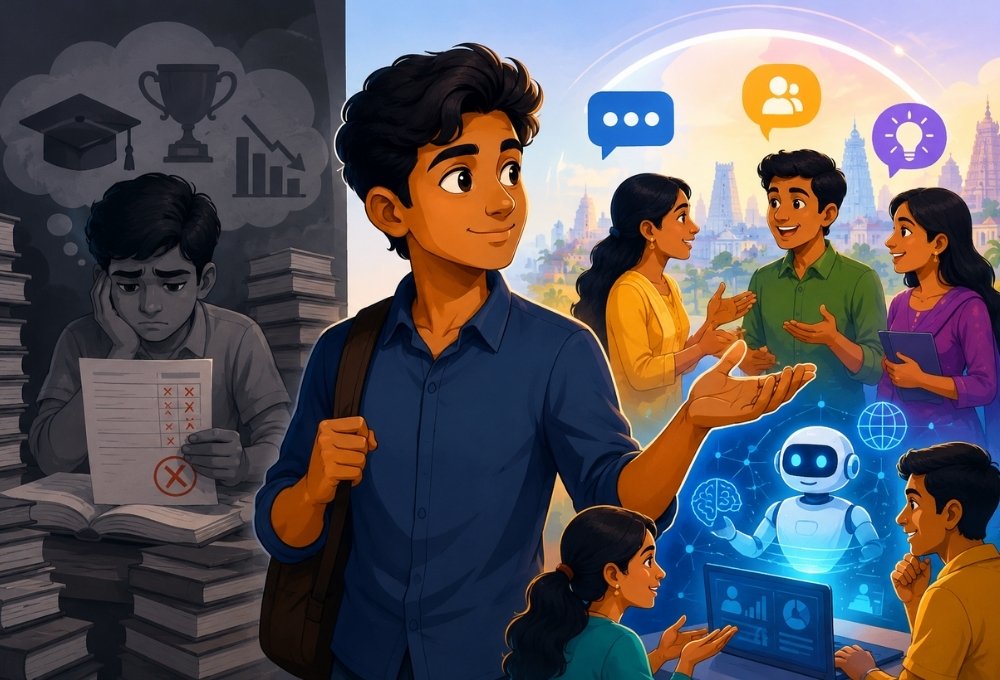

For generations, academic marks were treated as the ultimate measure of intelligence and success. Parents celebrated rank holders, schools emphasized examinations, and students were taught that high scores alone would guarantee a successful future. While academic excellence remains important, the modern world is rapidly changing the definition of what success actually looks like.
The rise of Artificial Intelligence has accelerated this transformation. Today, information is available instantly. AI systems can generate essays, summarize textbooks, solve equations, and automate repetitive tasks within seconds. As technology becomes increasingly capable of handling technical and analytical work, human-centered abilities are becoming more valuable than ever before.
Among these abilities, communication stands at the center.
Students who can express ideas clearly, speak confidently, collaborate effectively, and connect meaningfully with others are increasingly gaining an advantage in academics, careers, leadership, and entrepreneurship. In many situations, communication skills now influence opportunities more than marks alone.
At The Gift School, communication development is viewed not merely as a soft skill, but as a foundational life skill that shapes confidence, leadership, creativity, and long-term success.
The AI Era Has Changed the Value of Human Skills
One of the biggest shifts happening globally is the movement away from purely memorization-based education. Traditional education systems were originally designed for an industrial world where students were expected to follow structured systems and perform repetitive tasks efficiently. In such environments, memorization and examination performance were often sufficient indicators of capability.
However, the modern economy operates very differently.
Artificial Intelligence can now process information faster than humans. What technology still struggles to replicate consistently is emotional intelligence, creativity, persuasion, empathy, leadership, and authentic human interaction. These qualities depend heavily on communication.
This is why universities, companies, and educational institutions across the world increasingly prioritize abilities such as:
- communication and presentation skills
- collaboration and teamwork
- leadership and adaptability
- critical thinking and creativity
- emotional intelligence and social confidence
The future belongs not only to students who know information, but to students who know how to communicate ideas effectively.
Why Marks Alone Are No Longer Sufficient
Marks continue to matter in academic systems, but marks alone no longer guarantee future readiness. Many students graduate with excellent academic scores yet struggle in real-world environments because they lack confidence in communication and interpersonal interaction.
A student may understand concepts deeply but still struggle during:
- interviews
- presentations
- group discussions
- networking opportunities
- leadership situations
In contrast, students with strong communication abilities often adapt more quickly to new environments because they are comfortable expressing ideas, asking questions, building relationships, and participating actively.
Communication shapes how intelligence is perceived. A child who can articulate thoughts clearly often appears more confident, capable, and leadership-oriented. This ability influences classroom participation, social confidence, and eventually professional growth.
The modern world increasingly rewards visibility, clarity, and expression. In many cases, opportunities go not simply to the most knowledgeable individuals, but to those who can communicate their knowledge effectively.
Communication Shapes Confidence and Identity
Communication is deeply connected to self-confidence. Children who hesitate to speak often begin to internalize fear, self-doubt, and social anxiety. Over time, this hesitation can influence academic participation, creativity, and emotional development.
On the other hand, children who regularly engage in expressive activities gradually become more comfortable with their own voice. When students participate in storytelling, discussions, presentations, and collaborative learning environments, they begin to develop both communication ability and emotional resilience simultaneously.
Confidence is rarely built through pressure or comparison. It is usually developed through repeated positive experiences where children feel heard, encouraged, and respected.
Communication-based learning environments help children:
- express thoughts without fear
- organize ideas clearly
- participate more actively
- develop social comfort
- overcome stage fear gradually
As communication improves, confidence naturally grows alongside it.
Why Communication Skills Influence Career Success
One of the most significant misconceptions in education is the assumption that technical expertise alone guarantees professional success. In reality, communication influences nearly every stage of career development.
Professionals who communicate effectively are often better at:
- leading teams
- handling clients
- presenting ideas
- negotiating solutions
- building professional relationships
- adapting to changing environments
Even highly technical industries now prioritize communication because modern workplaces are collaborative by nature. Engineers, designers, doctors, analysts, entrepreneurs, and educators all depend on communication to translate ideas into action.
In the AI era, purely technical skills may become increasingly automated. Human communication, however, remains deeply valuable because it involves empathy, persuasion, emotional understanding, and leadership — qualities that technology cannot fully replicate.
Students who develop communication skills early gain an advantage that extends far beyond academics.
Why Parents Are Prioritizing Communication Development
Across India, parents are becoming increasingly aware that future success depends on more than examination performance alone. This shift explains the growing interest in:
- public speaking programs
- communication skills training
- personality development classes
- confidence-building activities
- leadership programs for students
Parents today understand that children must eventually navigate interviews, workplaces, leadership environments, and social interactions confidently. Communication affects all of these areas.
This changing mindset reflects a broader transformation in education itself. Families are beginning to prioritize holistic development rather than purely academic achievement. Skills such as communication, creativity, adaptability, and emotional intelligence are now viewed as essential life skills rather than optional extras.
How The Gift School Develops Future-Ready Students
At The Gift School Summer Camp 2026, communication development is integrated into interactive and experiential learning environments designed to help students become expressive, confident, and future-ready.
Rather than focusing exclusively on passive learning, programs encourage students to participate actively through storytelling, collaborative projects, presentations, leadership activities, and creative expression. This approach helps children build both confidence and communication ability in natural, engaging ways.
The objective is not merely to improve speaking ability, but to nurture students who can think independently, express ideas clearly, and participate courageously in the modern world.
The Future Will Belong to Communicators
As technology continues to evolve, human-centered skills will become even more valuable. The students who thrive in the coming decades will likely be those who can combine knowledge with clarity, creativity, empathy, and communication.
Communication is no longer simply a “soft skill.” It is a foundational survival skill for the modern era.
Children who learn to communicate effectively often become:
- more confident learners
- stronger leaders
- better collaborators
- more adaptable individuals
- more emotionally resilient people
Academic excellence remains important, but communication increasingly determines how far knowledge can actually take a person in the real world.
Final Thoughts
The AI era is transforming education, careers, and society itself. In this changing environment, communication skills are becoming one of the most important investments parents can make in a child’s future.
Marks may open doors initially, but communication often determines how far a child can grow once those doors are opened.
Children who can think clearly, speak confidently, collaborate effectively, and express ideas meaningfully will continue to hold a powerful advantage in the future. These are the students who are most likely to lead, innovate, and adapt successfully in a rapidly changing world.
Explore future-focused student development programs at The Gift School Official Website.
Frequently Asked Questions
Why are communication skills important in the AI era?
Communication skills help students lead, collaborate, express ideas clearly, and build meaningful relationships in a world where many technical tasks are increasingly automated by AI.
Are marks still important for students?
Yes. Academic performance remains valuable, but communication skills, leadership ability, emotional intelligence, and adaptability are becoming equally important for long-term success.
How can children improve communication skills?
Children improve communication skills through public speaking, storytelling, group interaction, presentations, collaborative learning, and confidence-building activities.
Why do employers value communication skills?
Employers value communication because it improves teamwork, leadership, problem-solving, collaboration, and the ability to present ideas effectively.
How does communication improve confidence?
As children learn to express ideas clearly and participate actively, they gradually become more comfortable socially and academically, which naturally improves confidence.